Ordering custom food packaging seems straightforward. Send the design, agree on price, wait for the cups or boxes to show up. Then reality hits. Wrong coating, delayed shipment, packaging that fails a simple leak test, or paperwork that doesn’t satisfy your market. A lot of buyers only learn these lessons after the first order goes wrong.
Here’s a practical checklist of what to ask a food packaging manufacturer or OEM packaging supplier before you commit money. These are the questions that actually matter when you’re looking at paper cups, kraft boxes, trays, and similar items.
Start with who they really are
Ask if they own the factory or if they’re just trading. A real manufacturer can usually talk about their machines, show photos of the workshop, and discuss tooling without sounding vague.
Get specific:
What exactly do you make in-house? paper cups, food boxes, pizza boxes, molded fiber trays?
Can you do both ready stock and full custom sizes?
Do you handle OEM printing and private label work?
Hydepackage is one example of a manufacturer that focuses on disposable paper packaging and biodegradable tableware. They produce custom paper cups, soup cups, kraft boxes, pizza boxes, paper bags, compostable bowls, trays, cutlery and the like. They take OEM and ODM orders, so logos and sizes can be adjusted.
Materials and food safety come next
This part is non-negotiable. You need clear answers on what the packaging is made of and whether it’s safe for food contact.
Ask them:
What material and thickness will you use?
What coating or lining is on it: PE, PLA, water-based, or nothing?
Can you send current food-contact reports for FDA, LFGB or the countries we sell to?
Do you have PFAS-free options and the lab data to back that up?
Are the inks and adhesives food-safe?
Don’t accept “yes, it’s fine.” Ask for the actual documents. Good suppliers already have them ready.
Minimums and how the price is built
MOQs can kill a project if they don’t match your volume.
Find out:
What’s the minimum for plain stock versus printed custom?
Does the minimum drop when you reorder?
What’s included in the unit price : plates, tooling, samples, packing?
Are there price breaks at higher volumes?
How do you handle overruns or short shipments?
Can you give a rough landed cost with freight?
Clear answers here stop the surprises later. Plenty of people start with a small trial once the specs are agreed.
Lead times that you can actually plan around
Everyone quotes a nice number. Push past that.
Ask:
How long for a first order and for repeats?
How much extra time for custom printing or a new mold?
What happens during peak seasons?
What’s your current capacity looking like?
Can you do partial shipments if needed?
Also ask how they tell you about delays. A supplier who speaks up early is easier to work with than one that goes silent.
Quality control and samples
Never skip real samples made the same way the big order will be made.
Cover these points:
Walk me through your QC steps from raw material to finished goods.
What sampling rate or AQL do you use?
What happens if something fails?
Can we lock in a golden sample and written acceptance criteria?
Do you test for leaks, heat or drops when it’s relevant?
Then test the samples yourself. Hot coffee, greasy food, stacking, lid fit. Approve only after that.
Certifications and paperwork
Certificates only help if they’re current and match your markets.
Request:
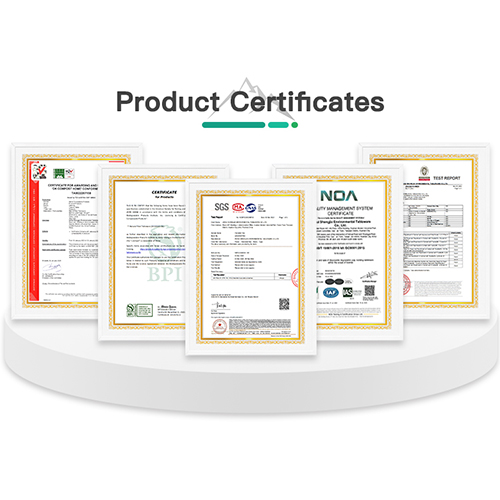
Copies of FDA, LFGB, SGS, FSC or whatever applies.
Food-contact declarations and any PFAS or migration test reports.
Factory quality system certificates if they have them.
Confirmation that the documents can go with the shipment.
Hydepackage lists several of the common ones , FDA, LFGB, SGS and others,which is what a lot of importers look for when sourcing paper cups and food packaging.
Custom work and day-to-day communication
Custom orders live or die on clear back-and-forth.
Ask:
What file formats do you need and how does proofing work?
How many artwork changes are included?
Who will I talk to during production?
How fast do you usually reply?
Can you mix different SKUs in one run if we need to?
A single contact who answers reasonably fast saves a lot of headaches.
Shipping and what happens after delivery
Make sure the order can actually arrive in usable shape.
Cover:
Case pack quantities and how it goes on the pallet.
Shipping choices and typical transit times.
How claims for damage or quality issues get handled.
Whether they help with reorders or inventory notes.
Write the answers down. A simple shared note keeps everyone on the same page.
How to use the list
Run these questions with two or three potential suppliers. Put the answers next to each other instead of deciding on price alone. Sometimes a slightly higher unit cost from a clear, responsive food packaging manufacturer ends up cheaper than dealing with problems from a cheaper but vague one.
Hydepackage is one OEM packaging supplier already making the kinds of products many foodservice and brand buyers need, custom paper cups in different styles, kraft boxes, compostable containers and more, with customization options and the certifications people usually ask for. The same checklist works whether you talk to them or someone else.
Spending a bit of time on these questions before the first order cuts risk and makes the relationship clearer. Packaging is a small line on most budgets until it fails. Asking the right things up front is almost always worth it.

 Paper Package
 Paper Package
 Biodegradable Tableware


 57145
57145 28214
28214




 (Saudi Arabia) Submit Demand 45 Minutes Ago
 (Australia) Submit Demand 25 Minutes Ago
 (United Kingdom) Submit Demand 36 Minutes Ago
 (Sweden) Submit Demand 15 Minutes Ago